Showing posts with label alternative energy. Show all posts

Is It Too Late For Renewable Energy?

You cannot define renewable energy that easily. It is the general term used for a whole range of unconventional energy sources, so the definition has to be all-encompassing. As most experts put it, renewable energy is any energy source that occurs naturally and very widely.

Most renewable energy sources are dependent on nuclear power. This nuclear power comes from the sun. In a huge nuclear reaction, the sun produces energy in the form of light and heat and this reaches the earth as natural sources of energy. The sun is the ultimate source of solar power, wind power, biomass energy and so on. Fossil fuels may be categorized under biomass energy, but are limitedly available and have plenty of disastrous side effects.

The US National Renewable Energy Laboratory has a great renewable energy program that finds the upcoming energy saving building methods. We have realized that energy efficiency is the best way to go, and this is where people will be educated in this aspect.

They work together with the leading instances of the building industry, foreground endeavors to build using renewable energy and tell producers as well as consumers about what and how they can save money by using this form of energy. NREL also get together with agencies to set guideposts for buildings and other energy consuming gadgets.

Renewable energy use is beneficial for the environment in the polluted world of today. Wind and solar energy are two of the most prominent types of this energy. Biofuels, geothermal energy and wave or tidal power are fast becoming popular, though some of these may potentially harm the natural world.

Is there any difference between renewable and alternative energy?

Many people don't know the fine difference between the two. Renewable energy is fundamentally natural; it's the energy we get from the sun, wind or waves. Alternative energy, however, includes both bio fuels and nuclear energy sources which are not really healthy options for us to use.

The infrastructure we have is suited for fossil fuels, even though renewable energy or green energy more cost effective. Our government has not been busy taking any steps to change things and go in for green energy sources. With the present situation worsening every day, we have to get a change really soon.

If we try to find one positive thing about fossil fuels it could be that we can store the energy we get from them, which is more difficult with green energy sources. Solar power, for instance, is less effective in cloudy weather. Calm days there is not very much use of a windmill. This and initial costs to get energy from these unconventional sources are still a bit high, could be a small drawback as compared to traditional earth-killing sources of energy.

About the Author

Eric Q. Duncan reveals "The Secret Trick To Use Energy More Wisely"; a free e-book about building a cost efficient home with green energy and also check his other site about renewable energy Grab a totally unique version of this article from the Uber Article Directory


Article Source Earth Articles Green Directory

Money Saving Ideas for Saving Your Home Energy

Many factors to save are facing us on a daily basis. Save money, save our planet, save the environment, save energy to name but a few.

But how many of us really take notice of these cries for saving. Many of us try to save money from our salaries, but with the low interest rates, how helpful is this?

In today’s slow economical world, there is one sure fire way you can save money on your household heating bills, along with helping the environment. C’mon, we all have to do out bit don’t we?

I work in the UK as an Energy Assessor covering Hampshire. During the past 3 years, I have seen firsthand how a great deal of money can be saved by making a few simple and cost affective changes to your home and in the way that you live on a day to day basis.

The first thing we all need to do is to increase the loft insulation (if you have one) to at least 270mm. This is really cheap to do, is very quick to facilitate and will stop your precious heat from escaping through the roof. If you feel inclined to, you can also insulate between the rafters for added protection. Just remember to leave gaps near the soffits to allow for air circulation as you could cause condensation if you don’t.

Next, if you have cavity walls, look at having these filled professionally to stop any heat being lost through them. If you have solid walls, you could look at having internal or external insulation applied, subject to any listing consents. From 1983 onwards, the building regulations stated that all properties built thereafter should have cavity wall insulation. From experience, this isn’t always the case and some builders have neglected this! Double check beforehand.

If you have an open fireplace which isn’t often used, consider using a chimney balloon. These are very cheap to buy, come in various sizes and can be inserted into the chimney to stop and down draughts or losing heat up through the fire place.

Another worthwhile exercise is to change all of your lights / light bulbs to low energy bulbs. The laws have recently changed and you can now only buy low energy bulbs. However, all too many homes are still clinging on to their old bulbs because they are brighter. They’re not! Today’s low energy bulbs are very bright and as time goes on they will get better and better. Much money can be saved using these bulbs not only through the electricity used, but they also last 10 times longer than our ‘old’ ones.

If you have a hot water cylinder with a jacket with your heating system, upgrade the jacket to at least 100mm to increase the insulation. Turn down the thermostat a little to save some energy. If you haven’t got a thermostat on your cylinder - then get one!

Whilst on the subject of heating. Ensure all of your radiators have Thermostatic Radiator Valves and turn them down or off if the room is unused. Ensure you have a room thermostat and again keep this low and finally, if you have a non condensing boiler, consider upgrading it to a condensing boiler.

In order to keep this article short, there are so many other ways to save money around the home. I will leave you with the thought of switching off electrical appliance at the mains when not in use. Items on standby, including the phone charger can use quite a bit of power.

Now, stop wasting money and protect our planet for the next generation.


About the Author

Simon from Property Assess is an independent Energy Assessor based in Hampshire offering Energy Performance Certificates (EPC’s) for residential properties.

Article Source Earth Articles Green Directory

Points To Remember When you Purchase Solar Panels

Fundamental amenities of every day life, today, comprise of electricity also along with food, shelter, and clothing. Life today is unimaginable without electricity or power. This is something that accompanies us the whole day and our entire life for that matter. Because of becoming the primary source of energy and therefore is awfully expensive. You are able to buy solar panel as an option.

One of the ways that could help reduce utility bills is really a solar panel. The solar panel makes use of solar energy to supply electricity. It's much less expensive when compared to the conventional electricity supply. In a solar panel, a collection of photovoltaic cells is tied together having a wire. This really is further backed by some sort of support and then is installed in households.

Before you purchase solar panel, there are several important points that are to become kept in thoughts. The initial point would be to obtain feedback from family members or friends who have already installed them in their houses. Their experience may help as a word of caution regarding any possible problems. This way such problems could be handled or avoided.

Product guarantee is one more important element that is to become kept in mind when preparing to purchase solar panels. Usually, all well known producers give 25 years of minimum item warranty which translates towards the truth that the merchandise is long lasting and the provider is trustworthy.

It is not good to be guided by inexpensive prices of solar panels. Extremely low priced panels will obviously be of poorer high quality and hence may not be that efficient. High quality, in case of any product, doesn't come inexpensive. It's appropriate to believed how the end-product is going to be equal towards the quantity paid. If the cost of the gear is much less, then undoubtedly the effectiveness of the merchandise will also match the cost of the merchandise.

It is usually a smart idea to compare prices and obtain several quotes from a couple of sellers prior to actually buying the product. However, difference in price is not the major concern when obtaining quotes because, occasionally it may so happen that, lower priced solar panels might be created up of poor high quality components and hence may result in huge maintenance costs or repair costs in the future.

One last word of caution isn't to get carried away through the words of salesmen trying to persuade you too much and putting higher quantity of pressure in purchasing the merchandise.


About the Author

Thanks for reading this article, and I really want to help you more, so I have included some links for you to look at, click here!: cheap solar panels and solar panels power
 
Article Source Earth Articles Green Directory

Search Amazon.com for buy solar panel 

Hydrogen Fuel Cells

A fuel cell is a device that uses hydrogen and oxygen to create electricity. Fuel cells are more efficient than combustion engines and the hydrogen used to power them can come from a variety of sources. If pure hydrogen is used as a fuel, fuel cells emit only heat and water, eliminating air pollutants or greenhouse gases.

Fuel Cell Stack
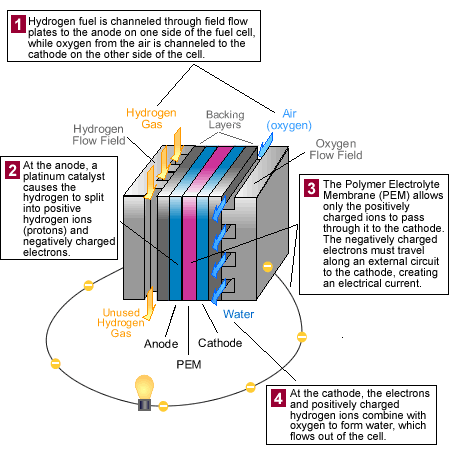
One of the more common types of fuel cell is the Polymer Electrolyte Membrane (PEM) fuel cell. The PEM fuel cell consists of an electrolyte membrane sandwiched between an anode and a cathode.


PEM
The PEM is a thin, solid, organic compound, typically the consistency of plastic wrap and about as thick as 2-7 sheets of paper. This membrane functions as an electrolyte: a substance that conducts charged ions (in this case protons), but does not conduct electrons. This allows the solution to conduct electricity. This membrane must be kept moist to conduct particles through it.


Anode
The anode is the electrode at which oxidation (loss of electrons) takes place. In a fuel cell, the anode is electrically negative.

Cathode
The cathode is the electrode at which reduction (gaining of electrons) takes place. In fuel cell, the cathode is electrically positive.

Flow Plates
Flow plates perform several important functions:
  1. They channel hydrogen and oxygen to the electrodes,
  2. They channel water and heat away from the fuel cell, and
  3. They conduct electrons from the anode to the electrical circuit and from the circuit back to the cathode.

The Chemical Process


Hydrogen fuel (H2) is channeled to the anode, where the catalyst separates the hydrogen’s negatively charged electrons from the positive protons.

The membrane allows the positively charged protons to pass through to the cathode, but not the negatively charged electrons.

The negatively charged electrons must flow around the membrane through an external circuit. This flow of electrons forms an electrical current.

At the cathode, the negatively charged electrons and positively charged hydrogen ions (protons) combine with oxygen to form water (H2O) and heat.

Fuel Cell
The amount of power produced by a fuel cell depends on several factors, including fuel cell type, cell size, temperature at which it operates, and pressure at which the gases are supplied to the cell. A single fuel cell produces less than 1.16 volts – barely enough to run the smallest applications.

Fuel Cell Stacks
To increase the amount of electricity generated, individual fuel cells are combined in series, into a fuel cell “stack.” A typical fuel cell stack may consist of hundreds of fuel cells.

Other types of fuel cells:


Source:   http://www.fueleconomy.gov/feg/fcv_PEM.shtml


Resources:

Search Amazon.com for Polymer Electrolyte Membrane
  1. Fuel Cell Fundamentals
  2. Designing and Building Fuel Cells
  3. RCi 2151AS Aluminum Fuel Cell With Sending Unit, Natural Aluminum Color, 15 Gallon, 18L x 20W x 10H
  4. Designing and Building Fuel Cells 
  5. Fuel Cell Systems Explained (Second Edition)
  6. Horizon Fuel Cell PEM Fuel Cell; Reversible; Functions as an electrolyzer and a fuel cell
Related Posts Plugin for WordPress, Blogger...