Showing posts with label fuel cells. Show all posts

Hydrogen Fuel Cells

A fuel cell is a device that uses hydrogen and oxygen to create electricity. Fuel cells are more efficient than combustion engines and the hydrogen used to power them can come from a variety of sources. If pure hydrogen is used as a fuel, fuel cells emit only heat and water, eliminating air pollutants or greenhouse gases.

Fuel Cell Stack
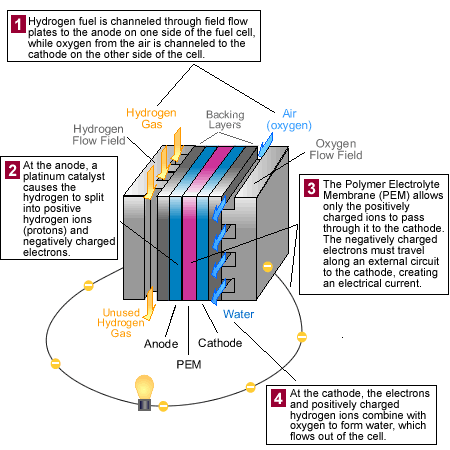
One of the more common types of fuel cell is the Polymer Electrolyte Membrane (PEM) fuel cell. The PEM fuel cell consists of an electrolyte membrane sandwiched between an anode and a cathode.


PEM
The PEM is a thin, solid, organic compound, typically the consistency of plastic wrap and about as thick as 2-7 sheets of paper. This membrane functions as an electrolyte: a substance that conducts charged ions (in this case protons), but does not conduct electrons. This allows the solution to conduct electricity. This membrane must be kept moist to conduct particles through it.


Anode
The anode is the electrode at which oxidation (loss of electrons) takes place. In a fuel cell, the anode is electrically negative.

Cathode
The cathode is the electrode at which reduction (gaining of electrons) takes place. In fuel cell, the cathode is electrically positive.

Flow Plates
Flow plates perform several important functions:
  1. They channel hydrogen and oxygen to the electrodes,
  2. They channel water and heat away from the fuel cell, and
  3. They conduct electrons from the anode to the electrical circuit and from the circuit back to the cathode.

The Chemical Process


Hydrogen fuel (H2) is channeled to the anode, where the catalyst separates the hydrogen’s negatively charged electrons from the positive protons.

The membrane allows the positively charged protons to pass through to the cathode, but not the negatively charged electrons.

The negatively charged electrons must flow around the membrane through an external circuit. This flow of electrons forms an electrical current.

At the cathode, the negatively charged electrons and positively charged hydrogen ions (protons) combine with oxygen to form water (H2O) and heat.

Fuel Cell
The amount of power produced by a fuel cell depends on several factors, including fuel cell type, cell size, temperature at which it operates, and pressure at which the gases are supplied to the cell. A single fuel cell produces less than 1.16 volts – barely enough to run the smallest applications.

Fuel Cell Stacks
To increase the amount of electricity generated, individual fuel cells are combined in series, into a fuel cell “stack.” A typical fuel cell stack may consist of hundreds of fuel cells.

Other types of fuel cells:


Source:   http://www.fueleconomy.gov/feg/fcv_PEM.shtml


Resources:

Search Amazon.com for Polymer Electrolyte Membrane
  1. Fuel Cell Fundamentals
  2. Designing and Building Fuel Cells
  3. RCi 2151AS Aluminum Fuel Cell With Sending Unit, Natural Aluminum Color, 15 Gallon, 18L x 20W x 10H
  4. Designing and Building Fuel Cells 
  5. Fuel Cell Systems Explained (Second Edition)
  6. Horizon Fuel Cell PEM Fuel Cell; Reversible; Functions as an electrolyzer and a fuel cell

The Hydrogen Highway is poised to take off

Toyota
The first hydrogen-vehicle refueling station fed by an active industrial hydrogen pipeline was opened in May in Torrance, Calif.

The first hydrogen-vehicle-refueling station fed by an active industrial hydrogen pipeline was opened on in May in Torrance, Calif., just across the road from Toyota's national headquarters. A collaborative effort among Toyota, Air Products, Shell, South Coast Air Quality Management District and the Department of Energy, the facility will provide hydrogen for the Toyota fuel-cell-hybrid demonstration-program vehicles as well as other manufacturers' fuel-cell vehicle fleets in the Los Angeles area. 

The hydrogen station is adjacent to the Toyota Motor Sales marketing headquarters. As landowner, Toyota leases the land to Shell for a nominal fee. As station owner/operator, Shell works directly with Air Products, which provides on-site equipment and station maintenance. The pipeline gas also is provided by Air Products from its plants in Wilmington, Del., and Carson, Calif.

Using pumps that are similar in appearance and operation (the nozzles have control levers much like those on typical gas pumps), the station provides a high-pressure supply for all types of fuel-cell vehicles. 

“Toyota plans to bring a fuel-cell vehicle to market in 2015 or sooner, and as you see, we will not be alone in the marketplace,” said Chris Hostetter, vice president of strategic resources for Toyota Motor Sales

“Building an extensive hydrogen-refueling infrastructure is the critical next step in bringing these products to market. But infrastructure development is no easy task. It will require coordination and cooperation between vehicle manufacturers, government agencies, hydrogen producers and end users. This station, for example, is the result of years of planning and a truly collaborative effort.”

Having the hydrogen pipeline mere yards from its front door provided Toyota with some other options. As Hostetter explains, “It created an opportunity for Toyota to explore other uses for hydrogen. In fact, Toyota has partnered with Ballard Power Systems to place a fuel-cell generator on our Torrance campus. The fuel cell will provide electrical power during peak-usage months and draw hydrogen from the same pipeline that supplies this station. The system is scheduled to come on line in 2012 and will reduce an estimated 10,000 tons of annual CO2 emissions.” 

The fuel-cell generator will be fed directly from the hydrogen pipeline through an existing tap on the TMS property. Pipeline hydrogen used on campus will be offset with the purchase of landfill-generated renewable biogas. Plans include using heat created by the fuel-cell system to provide hot water and space heating in the Toyota employee fitness center and in the Lexus headquarters building within the TMS campus. Use of this heat will offset natural-gas consumption on campus, thereby avoiding an estimated additional 28 tons of CO2 emissions annually.

Air Products teamed with Toyota and other fuel-cell vehicle manufacturers to develop the Hydrogen Vehicle Authorization System (HVAS), another first for the industry and unique to the Torrance station. The HVAS wireless-vehicle-recognition system allows station-to-vehicle recognition to facilitate quick and convenient fueling for customers.

The station also will feature a learning center on-site to provide hydrogen information and station information to local students and the public. Shell and Toyota will cooperate on the exhibits. With this new station, the city of Torrance will become part of the California Hydrogen Highway initiative, which aims to create clean-air solutions and develop new technology jobs across the state. 

For more information on the Hydrogen Highway initiative, visit http://www.hydrogenhighway.ca.gov/

By BARRY WINFIELD on 5/18/2011
Related Posts Plugin for WordPress, Blogger...